
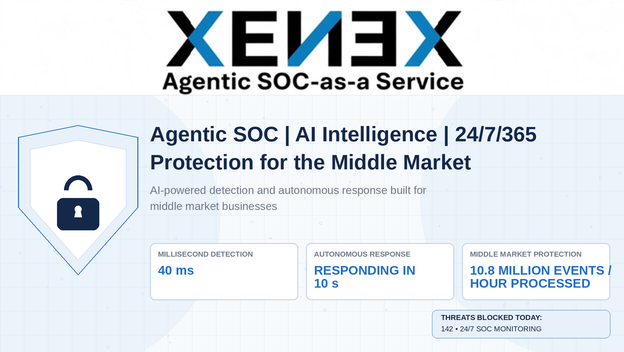
For the middle market, cybersecurity has always been an uneven fight. Mid-size organizations face the same ransomware crews, credential thieves, and business email compromise schemes that target the Fortune 500 — but without the budget, staffing, or bench depth to match them. That mismatch is exactly why a new operating model, the Agentic SOC, is gaining traction as a way to deliver enterprise-grade protection at mid-market scale.
What Is an Agentic SOC?
Traditional security operations centers follow a linear, human-gated process: Alert → Queue → Analyst → Investigation → Response. Each step adds latency, and latency is exactly what modern attackers exploit. By the time a human analyst reaches an alert, an attacker may have already moved laterally through the network.
That gap is measurable, and it’s shrinking fast. Independent research puts the average breakout time — the time it takes an attacker to move from initial compromise to lateral movement — at just 29 minutes in 2025, down from 48 minutes the year before and 98 minutes five years earlier. The fastest recorded breakout was 27 seconds.
An Agentic SOC inverts the traditional model to close that gap: Telemetry → AI Signal → AI Hypothesis → Autonomous Action → Human Validation. Instead of waiting in a queue for a person to notice a threat, AI systems continuously correlate signals across the environment, form a hypothesis about what’s happening, and take pre-approved containment action immediately — with a human validating the decision rather than initiating it.
In practice, that means an Agentic SOC platform delivered as a service typically combines:
- Broad, technology-agnostic telemetry ingestion across cloud, on-prem, and hybrid environments — no rip-and-replace of existing tools
- Cross-layered, real-time detection that blends heuristic rules with AI-driven pattern recognition
- A single pane of glass so a mid-size IT team can see the full picture instead of stitching together five different dashboards
- Autonomous containment that isolates an endpoint, disabling a compromised account, blocking a malicious IP that fires in seconds once a threat pattern is confirmed
Why Speed Is the New Currency of Security
Speed is no longer a nice-to-have. Ransomware and business email compromise attacks now execute in minutes, and human-only SOCs simply can’t keep pace. Ransomware is now present in 88% of confirmed breaches at organizations with fewer than 1,000 employees, compared with 39% at large enterprises, and global BEC losses topped $2.77 billion in a single year.
Sources: Verizon 2025 Data Breach Investigations Report; N-able 2025 Annual Threat Report
This is the core value of the Agentic model: detection that happens in milliseconds, correlated across endpoint, network, identity, cloud, and SaaS telemetry, paired with autonomous response that acts in seconds rather than hours. The difference between a contained incident and a breach headline often comes down to that window.
The Human Layer Still Matters
AI-driven detection is powerful, but AI without human context creates its own problem: alert fatigue. Industry research finds the average SOC fields somewhere on the order of 900 to 1,000+ alerts a day, with 50–80% turning out to be false positives, and roughly 90% of SOC teams reporting they feel overwhelmed by the volume.
Sources: Praetorian, “Alert Fatigue and False Positives”; Critical Start, SOC Annual Report
That’s why the most effective Agentic SOC models pair automation with a validation layer: experienced analysts who triage AI-flagged incidents, eliminate false positives, and hand a mid-market IT team a short, high-confidence list of what actually matters, instead of a queue of thousands of raw alerts. The goal isn’t to replace people with AI; it’s to let AI absorb the noise so the humans in the loop can focus on the signal.
Why This Model Fits the Middle Market Specifically
A few structural realities make the Agentic SOC-as-a-service model particularly well suited to mid-size organizations:
The talent gap is real and expensive. Running a true 24/7 SOC in-house typically requires 8–12 analysts, engineers, and threat hunters costing well over $1M in salary alone, before turnover, training, and tooling. The global cybersecurity workforce gap sits at an estimated 4.8 million unfilled roles, and 95% of security leaders report at least one skills gap on their team today. For most mid-market organizations, building that team from scratch simply isn’t realistic.
Source: ISC2 2025 Cybersecurity Workforce Study
Mid-market organizations are now primary targets, not afterthoughts. Ransomware operators have shifted their targeting toward this segment specifically: the median size of a ransomware victim organization was 228 employees in early 2025 — squarely in the middle market.
Source: Coveware, Quarterly Ransomware Report, Q1 2025
Compliance and insurance requirements keep rising. Cyber insurers increasingly require documented proof of 24/7 monitoring, MFA, EDR, log retention, and incident response plans before they’ll bind or renew a policy, and many mid-market organizations also carry regulatory obligations — FERPA, HIPAA, PCI, CMMC, NIST — that a generalist IT team isn’t resourced to manage alone.
Sources: Verizon 2025 Data Breach Investigations Report; industry cyber-insurance underwriting guidance, 2025
Put together, these pressures explain why “SOC-as-a-service” built on an Agentic model, rather than a stack of point tools a generalist IT team has to stitch together, has become the more realistic path to real protection for organizations in the 200–2,000 employee range.
What to Look for in an Agentic SOC Provider
Not every provider that uses the word “AI” is actually running an Agentic SOC. A few things worth asking about:
- Does detection and correlation happen in real time across your full environment, or only within a single tool?
- Is response genuinely autonomous for pre-approved actions, or does everything still wait in a human queue?
- Is there a real human validation layer that filters AI output before it reaches you — or are you still the one triaging thousands of raw alerts?
- Does the platform produce the documentation you actually need for cyber insurance and compliance audits?
- Is the provider transparent about what they see and do, or is it a black box you have to trust blindly?
XeneX SOC is the leading provider built around this model. The solution combines an AI-driven detection and response platform with a US-based analyst team that validates incidents before they reach a client’s inbox. Whichever provider you evaluate, the underlying model matters more than the marketing: the goal is AI that acts fast enough to matter, and humans who make sure it acts on the right thing.
Sources
Research cited above, for reference:
- Verizon, 2025 Data Breach Investigations Report — https://www.verizon.com/business/resources/reports/dbir/
- N-able, 2025 Annual Threat Report — https://www.n-able.com/resources/infographic-threat-report-2025
- Praetorian, “Alert Fatigue and False Positives” — https://www.praetorian.com/security-101/alert-fatigue-and-false-positives/
- Critical Start, SOC Annual Report (alert overload survey) — https://oodaloop.com/?p=215327
- ISC2, 2025 Cybersecurity Workforce Study — https://www.securityinfowatch.com/cybersecurity/article/55338497/cybersecurity-skills-gaps-now-outpace-headcount-shortages-isc2-workforce-study-finds
- Coveware, Quarterly Ransomware Report, Q1 2025 (via SMB cybersecurity statistics roundup) — https://www.swif.ai/blog/smb-cybersecurity-statistics