
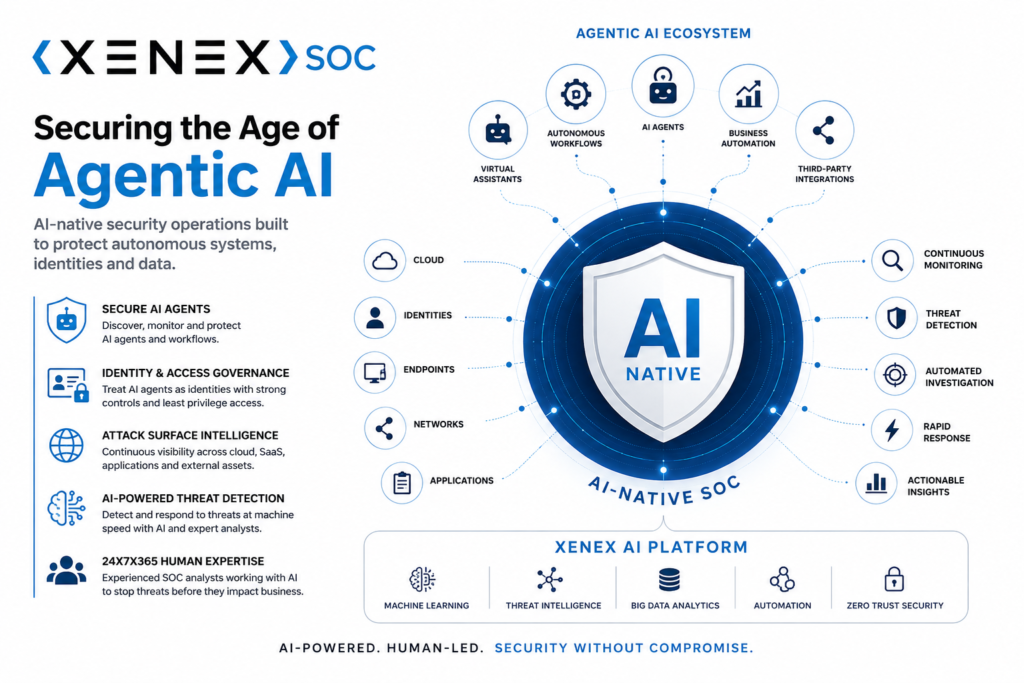
Artificial Intelligence is no longer limited to chatbots and automation tools. A new generation of technology—known as Agentic AI—is enabling autonomous systems to make decisions, execute tasks, interact with applications, and perform complex workflows with minimal human intervention.
Organizations are rapidly adopting AI agents to improve productivity, reduce costs, and accelerate business processes. However, as these intelligent systems gain access to critical applications, sensitive data, and operational workflows, they are also creating a new and largely unmanaged cybersecurity attack surface.
According to Gartner, Agentic AI oversight is one of the top cybersecurity trends shaping enterprise security strategies in 2026. Analysts predict that organizations will soon manage thousands—or even hundreds of thousands—of AI agents operating across cloud, SaaS, and business environments. Without proper governance and security controls, these systems can introduce significant cyber risk.
The Growing Security Risks of Agentic AI
Unlike traditional software applications, AI agents can make decisions, initiate actions, access multiple systems, and interact with sensitive data independently. While these capabilities create tremendous business value, they also create opportunities for attackers.
Security leaders are increasingly concerned about:
- Unauthorized access to AI agents and their credentials
- Excessive permissions granted to autonomous systems
- Prompt injection and AI manipulation attacks
- Data leakage through AI-powered workflows
- Shadow AI deployments outside IT visibility
- AI agents accessing regulated or sensitive information
- Compromised AI workflows that can rapidly scale attacks
Gartner recently identified prompt injection, AI application compromise, and AI-enabled social engineering as emerging threats requiring immediate attention from cybersecurity leaders. As organizations continue deploying AI capabilities, many lack visibility into where AI is operating, what data it can access, and how it is being used.
Identity Has Become the Foundation of AI Security
One of the most overlooked challenges of Agentic AI is identity management.
The National Institute of Standards and Technology (NIST) recommends treating AI agents as digital identities that require authentication, authorization, accountability, and least-privilege access controls. Every AI agent that accesses systems, data, or business processes effectively becomes another identity that must be monitored and secured.
Without strong identity governance, organizations risk creating thousands of privileged AI accounts operating with little oversight.
As AI adoption accelerates, identity security and continuous monitoring become essential components of cyber resilience.
Why Traditional SOCs Are Struggling to Keep Pace
Most Security Operations Centers were designed for a world where human analysts investigated alerts, correlated events, and responded to threats manually.
Today’s threat landscape is dramatically different.
Security teams face:
- Increasing volumes of security data
- More sophisticated cyberattacks
- Expanding cloud environments
- Identity-based threats
- AI-powered attacks operating at machine speed
- A persistent shortage of cybersecurity talent
Traditional security operations often struggle to process and investigate the growing volume of alerts generated by modern environments. The gap between threat speed and human response continues to widen.
Organizations need security operations capable of keeping pace with autonomous technologies and AI-driven threats.
The Rise of the AI-Native Agentic SOC
This is where AI-native Agentic security operations are changing the game.
An Agentic SOC combines artificial intelligence, automation, threat intelligence, and expert human analysts to identify, investigate, and respond to threats at unprecedented speed.
At XeneX SOC, our managed Agentic SOC platform was built specifically to address the challenges of modern cybersecurity. By combining AI-powered threat analysis, attack surface intelligence, automated investigations, and 24x7x365 monitoring, XeneX helps organizations detect and respond to threats before they become business disruptions.
Rather than replacing human analysts, AI enables them to focus on high-value security decisions while eliminating repetitive and time-consuming tasks.
This approach allows organizations to:
- Reduce alert fatigue
- Accelerate threat detection and response
- Improve visibility across cloud, endpoint, network, and identity environments
- Identify emerging AI-related threats faster
- Strengthen governance and compliance initiatives
- Enhance security outcomes without increasing staffing requirements
Securing the Future of Autonomous Business Operations
Agentic AI is transforming how organizations operate. The question is no longer whether AI agents will become part of business processes—it is how organizations will secure them.
Security leaders should be asking:
- Do we know where AI is being used across our organization?
- What systems and data can our AI agents access?
- Are AI identities properly governed and monitored?
- Can we detect AI-specific attacks and misuse?
- Do we have continuous monitoring and response capabilities in place?
Organizations that address these questions today will be far better positioned to manage the risks and opportunities of AI tomorrow.
Why XeneX SOC Is Built for the AI Era
The future of cybersecurity will be defined by a race between AI-powered attackers and AI-powered defenders.
Organizations need more than traditional monitoring tools. They need intelligent security operations capable of detecting threats, analyzing risk, and responding at machine speed.
XeneX SOC combines managed Agentic SOC threat detection, attack surface intelligence, and identity-focused monitoring with expert security analysts to help organizations navigate the rapidly evolving world of Agentic AI.
As autonomous systems become embedded into everyday business operations, security operations must evolve alongside them.
The future belongs to organizations that can harness the power of AI while maintaining visibility, governance, and security. With an AI-native SOC, that future becomes achievable.
Sources
- Gartner, Top Cybersecurity Trends for 2026
- Gartner, Six Steps to Manage AI Agent Sprawl
- Gartner, Assessing Risks in Agentic AI Deployments
- Gartner, Four Critical Threats Requiring Urgent Improvements from Cybersecurity Leaders
- Gartner, AI Governance and Trust, Risk and Security Management (TRiSM)
- NIST, Why Agentic AI Needs a Strong Identity Foundation